

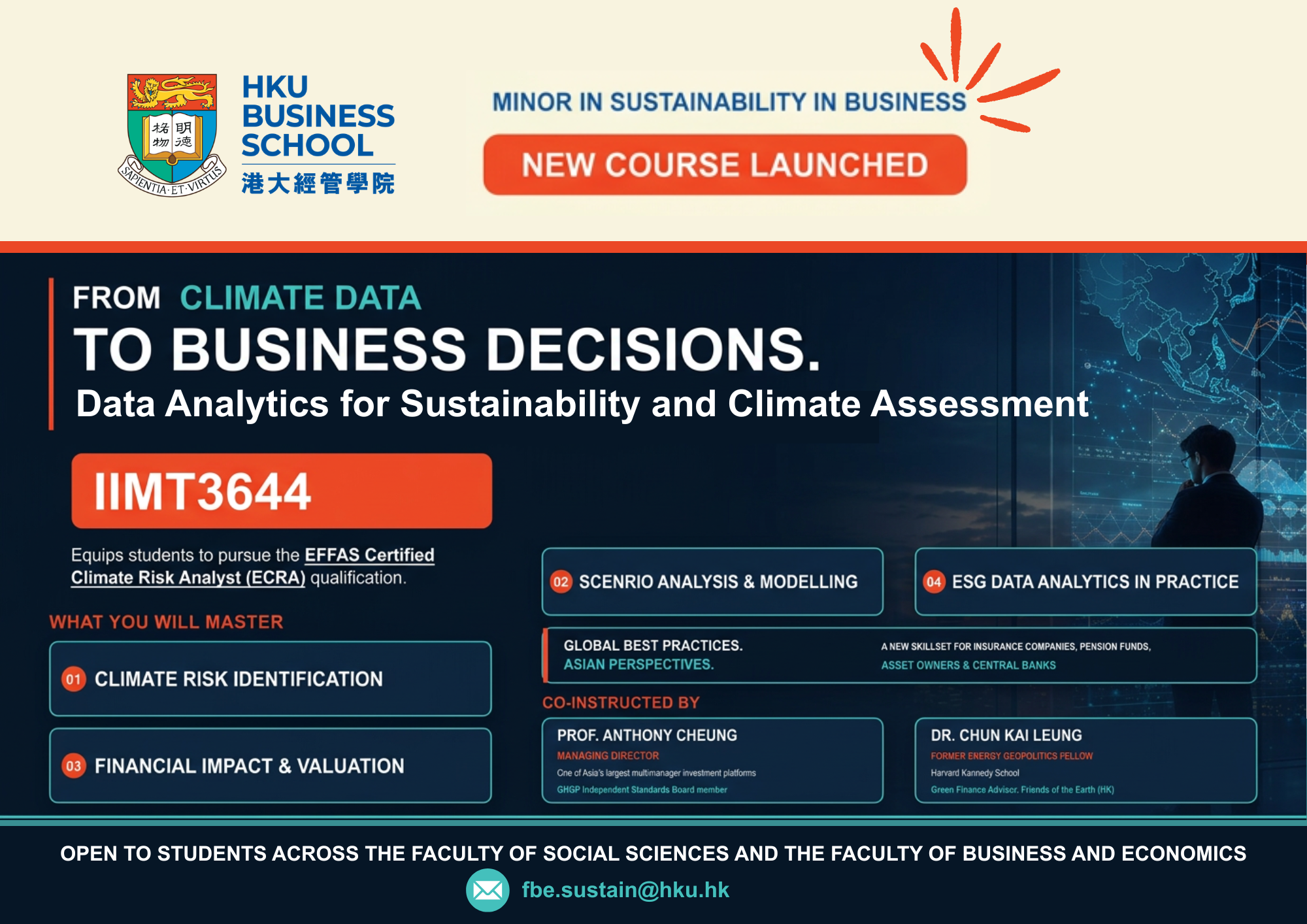
Earn Your EFFAS ECRA Certification: Enrol Now in IIMT3644 Data Analytics for Sustainability and Climate Assessment!
Climate and ESG risk has become one of the most financially material issues facing corporations, investors, and regulators worldwide. HKU Business School is delighted to introduce IIMT3644 Data Analytics for Sustainability and Climate Assessment, a new undergraduate course offered in the first semester of the academic year 2026-27. This course equips students to interpret, analyse, and apply sustainability and climate-related data in real business and financial decision-making: from physical and transition risk identification to net-zero planning and sustainable finance.
Students will develop hands-on proficiency with the real-world ESG and climate datasets used daily by practitioners (including Bloomberg, S&P Global, and LSEG Refinitiv) learning to evaluate the provenance, scope, methodology, and limitations of the data that underpins institutional ESG and climate-risk analysis.
No prior programming or Python experience is required: The course is deliberately designed around practitioner-style data interpretation and decision frameworks rather than coding, making it accessible to all undergraduate students regardless of technical background.
The course will prepare interested students to sit for the international EFFAS Climate Risk Analyst (ECRA) certification examination.
Click HERE for the full course outline of IIMT3644.
📍 New Class Time and Venue
Room MB122, 4:00–7:00 PM (Monday)
Please note the class has been scheduled in MB122 on Mondays, 4:00–7:00 PM, offering a focused three-hour weekly session dedicated to practical, data-driven sustainability and climate analysis.
EFFAS ECRA Certification
The EFFAS Climate Risk Analyst (ECRA) programme is a specialised international qualification that trains professionals to identify, assess, and quantify climate-related physical and transition risks, and to translate these into financially material analysis for investment, lending, and corporate decision-making. Students who complete IIMT3644 will be well positioned to pursue this globally recognised credential, joining the CESGA certification already offered through FINA3385 as part of HKU Business School's suite of practitioner-aligned ESG and sustainability qualifications.
Disclaimer: The School will not be responsible for any expenses incurred in relation to external certification examinations. Data collected through any external registration process is solely administered by the relevant certifying body.
Course Instructors
Dr. Chun Kai Leung | Prof. Anthony Cheung
What ths Course is about
This course equips students to interpret, analyse and use sustainability and climate-related data in business and financial decision-making. It develops robust data literacy without requiring programming: the ability to evaluate the scope, assumptions and limitations of ESG, environmental, climate and socioeconomic datasets. Students work with real-world data, scenarios and analytical frameworks used by corporations, investors, financial institutions, asset owners, insurers and regulators, gaining direct, practitioner-level exposure to leading ESG data platforms such as Bloomberg, S&P Global, and LSEG.
Built around the EFFAS Climate Risk Analyst (ECRA) programme, the course links climate science and policy to physical and transition risk analysis, financial-impact quantification, climate opportunities, net-zero and adaptation planning, macro-financial effects, sustainable finance and asset-class analysis. It bridges academic rigour with industry practice and prepares interested students to sit the international ECRA examination.
Course Objectives
● Explain the scientific, policy, regulatory and reporting foundations of climate-related analysis.
● Critically evaluate sustainability and climate datasets, methodologies, assumptions, limitations and fitness for decision use.
● Identify and model physical and transition climate risks using scenarios, exposure, vulnerability and time-horizon concepts.
● Translate climate risks and opportunities into financially material analysis and decision-support workflows.
● Evaluate credible net-zero and adaptation plans, economic and financial-stability effects, sustainable-finance instruments and asset-class implications.
● Communicate evidence, uncertainty and recommendations clearly to technical and non-technical audiences, and apply the course methods in individual and team-based cases.
Offering Semester in 2026-27
First Semester
Class Schedule *Updated*
Monday 4:00–7:00 PM | Room MB122
Major/Minor (Course Category)
Major in Business Analytics (Disciplinary Elective (List B))
Minor in Sustainability in Business (SIB) (Disciplinary Elective)